
Backtested Strategies Announces BTS Zones — Major Indexes Backtest Results
Backtested Strategies announces BTS Zones — Major Indexes Backtest Results, a new report showing that a long-only, SPY-relative allocation model grew a $10,000 starting account to $182,069 in a 2004–2025 backtest, versus $91,344 for buy-and-hold SPY.
BTS Zones — Major Indexes Backtest Results is a strategy research report that converts the firm’s proprietary heatmap zone windows into a defined allocation framework using five major-index ETFs: QQQ, MDY, IJR, IYT, and XLU, with SPY as the neutral default and SHY as the defensive holding. The strategy uses Relative Strength Zones for offensive allocation and SHY only after confirmed Relative Weakness Zone downside warnings.
The report evaluates whether BTS’s proprietary heatmap rotation improved on a buy-and-hold SPY benchmark while remaining long-only and allocating only among confirmed Relative Strength Zone ETFs, SPY, and SHY.
What the strategy showed
Across the 2004–2025 whole-calendar-year report window, BTS Zones produced 14.1% CAGR versus 10.6% for SPY. A $10,000 starting account finished at $182,069 for BTS Zones versus $91,344 for buy-and-hold SPY.
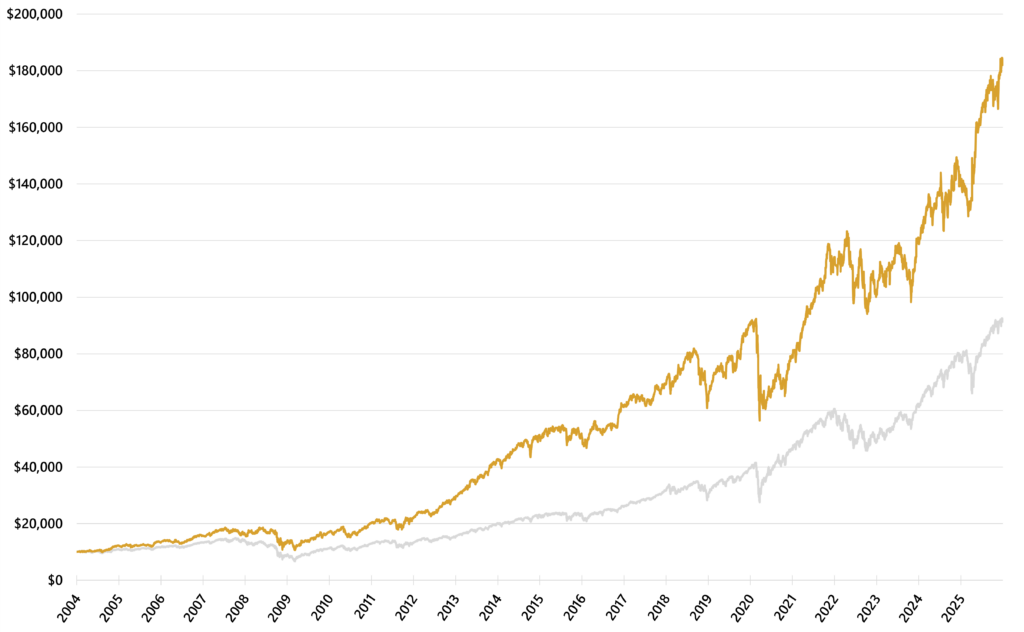
BTS Zones also reduced maximum drawdown, falling -42.9% at its worst point versus -55.2% for SPY. It recovered from that maximum drawdown on April 15, 2010, compared with August 16, 2012 for SPY, while running at higher volatility: 20.2% versus 18.8%.
The result is best read as return leadership with drawdown improvement, not as a low-volatility or crash-avoidance result.
Participation with selectivity
The model remained invested for nearly the entire test, so the result came from allocation choices rather than hiding in cash. It shifted toward confirmed leadership windows, used SPY as the neutral default, and used SHY only after downside confirmation when no confirmed Relative Strength Zone ETF had priority.
The report also separates results by SPY up years and SPY down years. In SPY up years, BTS Zones produced 18.7% CAGR versus 16.6% for SPY; in SPY down years, BTS Zones produced -11.2% CAGR versus -21.0% for SPY.
Across overlapping holding periods, results were positive but not uniform. The strategy beat SPY on rolling CAGR in 152 of 229 three-year windows, or 66.4%, and 138 of 205 five-year windows, or 67.3%. However, SPY had the stronger median five-year profile, with higher median rolling CAGR, lower median volatility, and higher median rolling Sharpe.
Lower volatility was not the core edge: BTS Zones had lower volatility in 31 of 229 three-year windows, or 13.5%, and 0 of 205 five-year windows. The results point to participation with selectivity, not all-weather smoothing.
Results are shown under BTS Methodology, which requires each strategy’s execution convention to be stated. The methodology also standardizes the surrounding simulation framework: data alignment and true-bar handling, execution-price modeling, trading costs and spread-aware slippage, sizing and portfolio accounting, cash and dividend treatment, benchmark total-return treatment, terminal closeout, reporting-window conventions, and performance metric calculations.
Backtests are historical simulations, not forecasts. The report is research material and does not provide personalized investment advice.
Read the report
The full BTS Zones — Major Indexes Backtest Results report includes preview and full-period metrics, equity-curve and drawdown-profile charts, caution flags, failure-mode analysis, calendar-year returns, SPY up-year and down-year analysis, rolling-window results, pseudocode, and implementation guardrails.
Read BTS Zones — Major Indexes Backtest Results.
About Backtested Strategies
Backtested Strategies (BTS), operated by Marquantex LLC, is a financial research publisher focused on evidence-based strategy research, standardized backtests, and investor research tools. Methodology is the foundation of BTS: clearly stated rules, consistent assumptions, benchmark context, and plain-English interpretation help investors evaluate market ideas without relying on hype, hindsight, or unsupported claims.
Learn more at Backtested Strategies.